Introduction
Polyacrylamide in papermaking has become a critical factor in achieving consistent paper formation and strong mechanical performance as the pulp and paper industry continues to evolve. With global paper production facing pressure from rising raw material costs, higher recycled fiber usage, and stricter environmental standards, mills increasingly rely on advanced wet-end chemistry to maintain quality and efficiency. Among all wet-end additives, polyacrylamide, commonly known as PAM, plays a central role in improving paper formation, enhancing strength, and stabilizing machine performance.
Used primarily as a retention and drainage aid, polyacrylamide directly influences how fibers, fines, and fillers are distributed and bonded within the paper sheet. Its impact extends beyond process efficiency, shaping key quality parameters such as tensile strength, burst resistance, and internal bonding. This article explains how polyacrylamide affects paper formation and strength, why correct selection matters, and how paper manufacturers can optimize performance with support from reliable suppliers.
Polyacrylamide and Its Function in Papermaking
Polyacrylamide is a high-molecular-weight, water-soluble polymer derived from acrylamide monomers. In papermaking, it is available in cationic, anionic, and non-ionic forms, with cationic polyacrylamide being the most widely applied due to its strong interaction with pulp components.
Paper furnishes naturally carry a negative charge. Cellulose fibers, fines, and fillers such as precipitated calcium carbonate, ground calcium carbonate, and kaolin clay all contribute to this anionic environment. Cationic polyacrylamide interacts electrostatically with these materials, anchoring them together through polymer bridging. Anionic polyacrylamide operates differently, relying on charge-neutralized sites created by coagulants or multivalent ions, making it particularly effective in drainage systems and water clarification.
The effectiveness of polyacrylamide depends on matching molecular weight, charge density, and polymer type to the specific furnish, paper grade, and machine conditions. Working with experienced suppliers such as Chemtradeasia allows mills to access tailored PAM grades that align with both quality and productivity goals.
Paper Formation and Strength as Quality Indicators
Paper formation describes the uniformity of fiber and filler distribution across the sheet surface. Good formation results in even appearance, consistent printability, and predictable mechanical properties. Poor formation leads to visible streaks, weak spots, and variability that affects downstream converting and end-use performance.
Paper strength refers to a group of mechanical properties that determine how the sheet performs during processing and use. These include tensile strength, burst strength, tear resistance, and internal bond strength. All of these properties depend on how effectively fibers bond with one another and how evenly fines and fillers are distributed within the sheet.
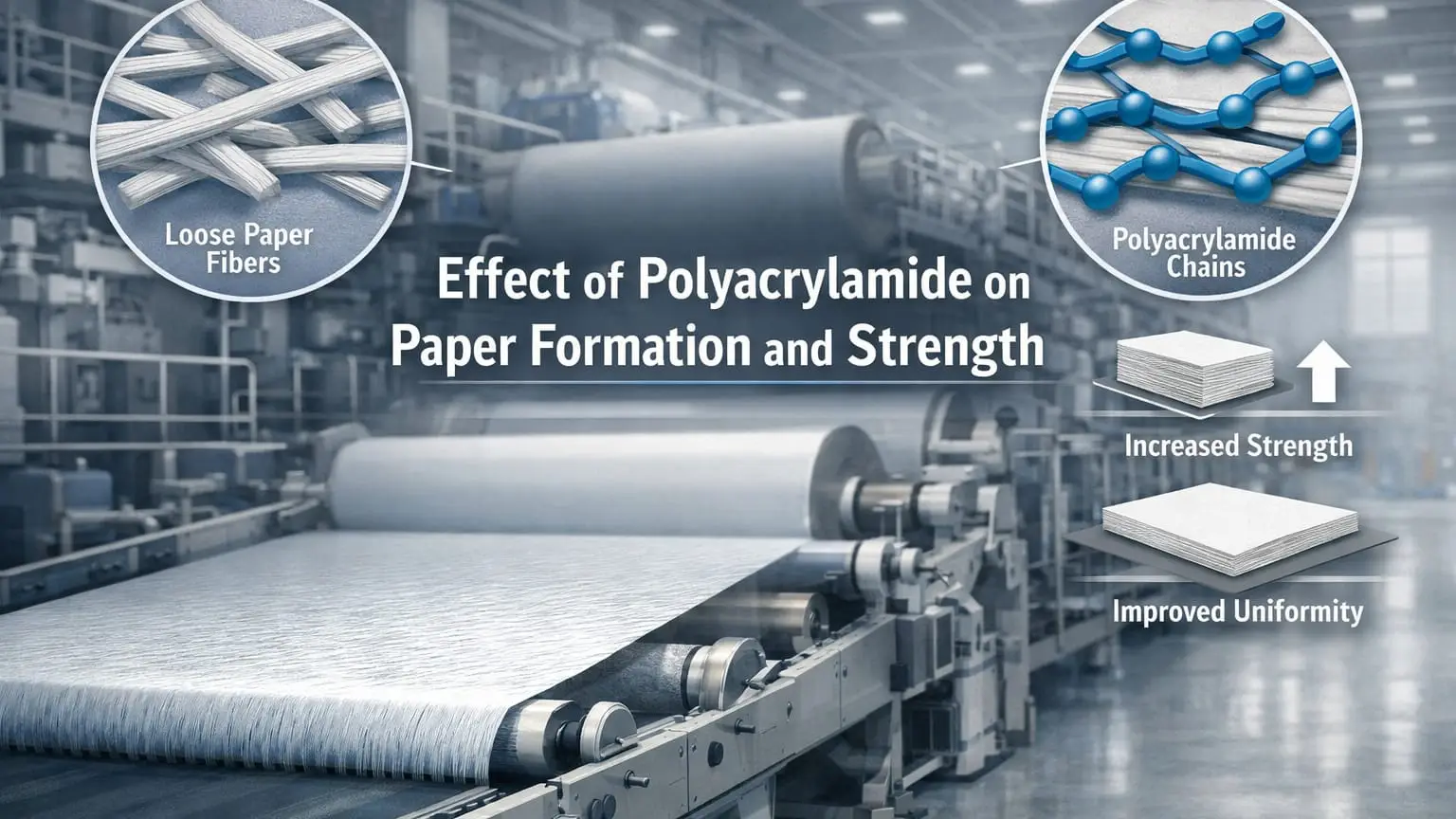
Polyacrylamide supports both formation and strength by improving retention of fines and fillers, increasing fiber bonding sites, and stabilizing the sheet structure during formation and drying.
How Polyacrylamide Improves Formation and Strength
The primary mechanism behind polyacrylamide performance is controlled flocculation. Long polymer chains adsorb onto fiber and filler surfaces, creating bridges between particles. This reduces electrostatic repulsion and forms flocs that can withstand machine shear while remaining flexible enough to redistribute evenly.
When flocculation is properly controlled, retention improves without sacrificing formation. Fibers and fines remain in the sheet rather than being lost to the white water system, while turbulence in the approach flow and headbox breaks flocs into smaller, evenly distributed aggregates. This balance is essential for achieving uniform formation.
At the same time, polyacrylamide acts as a high-efficiency retention aid. Without PAM, a significant portion of fines, fillers, and functional additives would exit the system with process water. PAM can increase filler retention from typical levels of 40 to 50 percent up to 80 or even 90 percent under optimized conditions. Higher retention stabilizes sheet composition and directly contributes to improved strength.
Retention Control and Its Impact on Sheet Structure
Retention plays a decisive role in both formation quality and strength development. Polyacrylamide improves retention by linking fibers, fines, and fillers into structured networks that remain embedded in the sheet during drainage.
Improved retention leads to higher sheet density and more uniform fiber distribution. Retained fines fill voids between fibers, increasing contact area and promoting stronger hydrogen bonding during drying. This effect enhances tensile strength, burst strength, and internal bonding while reducing variability across the sheet.
In addition, better retention lowers solids concentration in white water, stabilizing wet-end chemistry and reducing the need for corrective chemical additions.
Polyacrylamide and Formation Control
Polyacrylamide influences paper formation by regulating floc size and strength. High-molecular-weight polymers tend to form larger flocs, which improve retention but require careful control to avoid formation defects. Charge density determines how strongly the polymer adsorbs to fibers and fillers, influencing both floc stability and redistribution under shear.
Modern papermaking systems often use dual-polymer or microparticle programs to refine this balance. Cationic polyacrylamide may be combined with anionic PAM, bentonite, or colloidal silica to break down large flocs into smaller, more evenly dispersed structures after initial retention. This approach improves formation while maintaining high retention efficiency.
Contribution of Polyacrylamide to Paper Strength
Polyacrylamide improves paper strength primarily by enhancing fiber-to-fiber bonding. Retained fines act as micro-bridges within the sheet, increasing the number of bonding points and strengthening the overall fiber network.
As a result, PAM contributes to higher tensile strength, improved burst resistance, better tear performance, and stronger internal bonding. Cationic polyacrylamide generally delivers the most noticeable dry strength improvements due to its strong adsorption onto fiber surfaces. Modified variants, such as glyoxalated polyacrylamide, further enhance dry strength performance in demanding applications.
While wet strength typically requires dedicated resins, polyacrylamide establishes a strong structural foundation that supports overall sheet integrity.
Conclusion
The effect of polyacrylamide on paper formation and strength is fundamental to modern papermaking performance. By controlling retention, fiber bonding, and floc structure, PAM enables mills to produce stronger, more uniform paper while improving efficiency and cost control.
As paper manufacturers continue to balance quality demands, recycled fiber usage, and sustainability goals, polyacrylamide remains a strategic wet-end additive. Partnering with trusted suppliers such as Chemtradeasia ensures access to consistent-quality polyacrylamide and technical expertise, helping mills optimize formation, enhance strength, and stay competitive in the global paper industry.